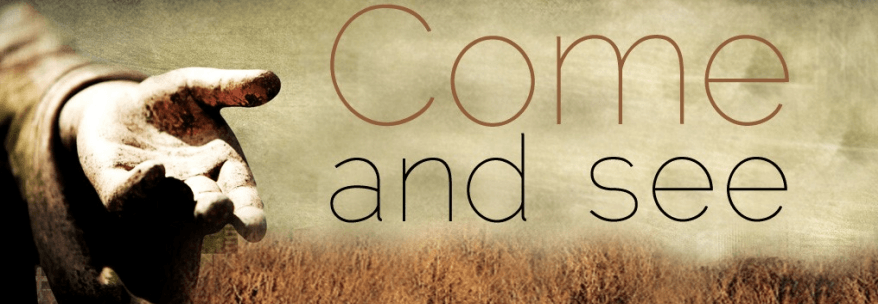
Come and see

Webmaster • January 16, 2021

Starting our journey through Ordinary Time, the gospel begins with looking, gazing, and responding to the call to discipleship. John the Baptist stands with two of his disciples, ready to decrease in significance so that Jesus may increase (c.f. John 3:30). After his testimony there will be no hanging onto his former disciples. John watches Jesus pass by; the eyes of his heart penetrate to the reality of this man, and he points him out to his disciples as the Lamb of God. The Jewish religious experience of the lamb was as the sacrificial offering that overcame the alienation of sin and created unity between the people and God. In whatever way the Baptist’s disciples understood his words, they were spoken with an urgency that made them leave John to follow Jesus. Jesus himself turns and sees them. The word the evangelist uses for ‘saw’ (theásthai) has the sense of gazing contemplatively and engagingly at these two followers. Jesus then asks them his first question in the fourth gospel: “What are you looking for?” It is a question that will persist throughout this gospel, from the first chapter through to the garden of the resurrection morning, but by then the ‘What’ has become ‘Whom’ in the intimate encounter with Mary Magdalene (John 20:15). The two disciples ask the Teacher (Rabbi), where he is staying, and he responds by inviting them to ‘Come, and see.’ Their question is about a place; their experience is about abiding for the rest of the day in a relationship with a person, about the beginning of a new communion between the people and this Lamb of God. The ‘where’ is not as important as the ‘with whom.’ A pattern of discipleship is established: through witness (of the Baptist), others follow and experience Jesus’ truth for themselves. They in turn bring others to Jesus. One of the first who followed Jesus remains anonymous, perhaps as a Johannine invitation to future readers to see a challenge in the following, seeking pattern of discipleship. The other is later named as Andrew, who announces to his brother, Simon Peter, that he has found the Messiah. Like the first disciples, we all see something different in this same Jesus, and Jesus recognises the truth in us, just as in this first chapter of the fourth gospel, Jesus’ insight into Simon’s role in the community of the disciples suggests his renaming as Cephas (in Aramaic, kepha; in Greek, petra; in English, rock). The gospel proclaims that discipleship is an active and involving relationship with Jesus: a following, seeking, staying, finding, and dialoguing with him. We hear how each decision to follow Jesus is a response to a statement about Jesus’ identity as Lamb of God, Rabbi, Messiah, by people whose ears and hearts are open to the Word of God, who hear his invitation through the words of friend or stranger, through events of joy or sorrow, or who discern a moment of religious significance in the everyday.
By Webmaster May 26, 2026
There is a global debt crisis causing immense suffering for our brothers and sisters in low-income countries. Money that should be spent on healthcare and education is flowing out from countries that can least afford it. Complex factors have caused this crisis and now governments have an impossible choice between serving their people or paying their creditors. Often, they have paid their original debt back, but spiralling interest means they will never break the cycle. There are practical solutions are available. Please sign the petition at: www.cafod.org.uk/cancelthedebt
By Webmaster May 26, 2026
A usual the Diocese asks all Extraordinary Ministers of the Eucharist to renew their commitment to their important ministry on the feast of Corpus Christi. At present we only receive the chalice at the 09.00 and 11.00 Masses on Sunday so the renewal will take place at these two Masses on Sunday 7th June (Corpus Christi). Ministers will be asked to come and stand at the front of the sanctuary by Fr Daryl when they are required, renew their commitment and then return to their places in the congregation (except for those who are ministering at the Mass that day). Immediately after Mass those who have renewed their commitment are asked to go to the sacristy and sign next to their name.
By Webmaster May 26, 2026
For administration purposes, it is necessary to cleanse the Euro Car Park database of Registered Parishioner Cars. The last time this was done was in 2021. In the next few weeks, the system will have an ‘auto-purge’ so that all vehicles that are currently registered but have not used in the car park for the last six months will be purged from the system (ceasing to be ignored by the cameras). If you are a Registered Parishioner and have a car that you wish to remain on the system, that you have not used in the last six months – please contact the Parish Office ( cobham@abdiocese.org.uk ) to have the vehicle re-registered. Thank you
By Webmaster May 26, 2026
Grateful thanks to all those throughout the Deanery who helped to arrange and facilitate our shared time of Eucharistic Adoration. To prayer leaders, musicians, those who signed up, those who 'popped' in, and the clergy our appreciation.  The fruits of this time we leave with the Lord and who knows maybe it is something we can do again.... Fr Simon Hall
By Webmaster May 26, 2026
Philip was a contradiction, combining popularity with piety against the corrupt backdrop of Rome and a disinterested clergy. Philip abandoned the chance to become a businessman, moved to Rome from Florence, and devoted his life to God. After three years of philosophy and theology studies, he gave up any thought of ordination. The next 13 years were spent in a vocation unusual at the time - that of a layperson actively engaged in prayer and the apostolate. As the Council of Trent (1545- 63) was reforming the Church on a doctrinal level, Philip’s appealing personality won him friends at all levels of society, from beggars to cardinals. He rapidly gathered together a group of laypersons won over by his audacious spirituality. Initially, they met for informal prayer and discussion, and also served the poor in Rome. At the urging of his confessor, Philip was ordained a priest and became an outstanding confessor himself, gifted with the knack of piercing the pretences and illusions of others, though always in a charitable manner and often with a joke; arranging talks, discussions, and prayers for them in a room above the church. Some of Philip’s followers became priests and lived together in community. This was the beginning of the Oratory, the religious group he founded.  After spending a day hearing confessions and receiving visitors, Philip Neri suffered a haemorrhage and died on the feast of Corpus Christi in 1595. He was beatified in 1615 and canonized in 1622.
By Webmaster May 26, 2026
If you ask a group of people how the apostles received the gift of the Holy Spirit, some will say through tongues of fire while others will say that Jesus breathed on them. We get the first image from today’s first reading from the Acts of the Apostles. The second image comes from John’s Gospel. How the apostles historically received the gift of the Spirit is less important than what resulted when the Spirit filled them. In both stories, the apostles changed from a group in hiding, fearful for their lives, to bold and confident proclaimers of God’s great works through Jesus. In the Gospel reading today, Jesus breathed on the apostles just as God breathed life into the first human. Like the readings from John’s Gospel that we’ve heard the last few weeks, Jesus is showing his friends that he is one and the same as God. Just as the first human came alive with God’s breath, so the apostles come alive in a new way when they receive the Holy Spirit. Before the coming of the Spirit, they were a fearful, closed group, hiding out, paralyzed to continue Jesus’ ministry of healing and teaching. Once Jesus came to them and offered them his peace and the gift of the Holy Spirit, they immediately transformed. Rejoicing replaced fear, and the willingness to move outward to minister to others replaced their desire for safety.  After Jesus breathed on the disciples, he tells them, “Whose sins you forgive are forgiven them, and whose sins you retain are retained.” This verse is often interpreted as the origin of priests’ authority to forgive sins, but it applies to all of us. Jesus is pointing out the power we all have in choosing how we respond to hurt. When we forgive others, we not only free them from our anger and resentment, we free ourselves from carrying those emotions. On the other hand, if we retain someone’s sins by refusing to forgive them, we are holding ourselves bound by anger, resentment, blame, and hurt. We are just as much the prisoner in the relationship. Our refusal to forgive affects not only the offending person, but us, as well. Questions of the week • When have you had the privileged experience of watching someone else move from fear to courage? How did God/the Holy Spirit play a role in that? • When have you experienced freedom by being forgiven by someone? When have you been able to free someone else by offering forgiveness?
By Webmaster May 24, 2026
OUR PARISH SUPPORTS THE COBHAM AREA FOODBANK Please can you help local people in crisis by purchasing items on the list below and placing them in the Foodbank’s collection point in the narthex when to come to Mass at the weekend? 
By Webmaster May 24, 2026
Our month of prayer for priestly vocations continues this weekend, with people across our diocesan community of faith asked to pray for a spirit of sacrifice, so that greater numbers of men might respond generously to God’s call to celebrate the sacrifice of the Mass. As members of the Church, we each have a vocation to build up God’s Kingdom. This call requires us to listen closely to God in prayer, and watch for the signs of His action in our lives.  God calls each person in a slightly different way; speaking through a personal relationship with Him, through the circumstances of your life and the people of God, and through the Church’s hierarchy. Copies of the ‘Month of Prayer for Vocations’ leaflet can be found in the church narthex
By Webmaster May 24, 2026
28th May, 12.00, Arundel Cathedral. Join the priests of our Diocese who are celebrating 25, 40, 50 and 60 years of priestly ordination, to give thanks for their years of service at this special Mass in Arundel Cathedral. All are welcome. [ PLEASE NOTE : due to the jubilarians Mass there will be no Mass in the Parish on Thursday 28th May.]
By Webmaster May 24, 2026
11.00 SUNDAY MASS COFFEE Rota Currently we are looking for parishioners (especially those who use the 11.00 coffee session) to consider becoming new members of the Coffee Rota (like any rota, the greater the number of volunteers the less often the same names crop up). This role is ideal for younger families to take part in as well as others (married or single).