HCPT (GROUP 151) PILGRIMAGE TRUST

Webmaster • June 26, 2026

Next weekend parishioners will be able to discover more about what Fr D does in Lourdes after Easter each year. The leader of the group that Fr D goes to Lourdes with each year is coming to talk about what it’s all about and to make an appeal for funds to enable the group to continue taking special needs children on the pilgrimage.


Since 1956, HCPT has offered life-changing week-long pilgrimage holidays to Lourdes, France, for special needs children. Such holidays are with small groups of prepared volunteer helpers. HCPT groups stay in hotels whilst in Lourdes.


HCPT pilgrimages are organised through a network of local groups across the UK and beyond. Each group is led by experienced volunteer Group Leaders and supported by a dedicated team of helpers, nurses, and group chaplains. Groups typically meet in the months before the pilgrimage to prepare. They travel together as a group - often by plane, train, or coach - and stay together in Lourdes for the week, taking part in HCPT’s full programme of fun.


The cost of the pilgrimage is just over £1,000 per person, although this can vary slightly depending on the group and travel arrangements. This includes return travel, full board accommodation, insurance, medical support, and access to all HCPT events in Lourdes. HCPT does not expect children to pay for their pilgrimage - each group fundraises to cover these costs, so that every child can travel regardless of their circumstances.

By Webmaster June 26, 2026
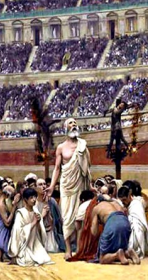
There were Christians in Rome within a dozen or so years after the death of Jesus, though they were not the converts of the “Apostle of the Gentiles” (Romans 15:20). Saint Paul had not yet visited them at the time he wrote his great letter in 57-58 A.D. There was a large Jewish population in Rome. Probably as a result of controversy between Jews and Jewish Christians, the Emperor expelled all Jews from Rome in 49-50 A.D. Suetonius the historian says that the expulsion was due to many disturbances in the city “caused by the certain Christus” [Christ]. Perhaps many came back after the Emperor’s death in 54 A.D. Paul’s letter was addressed to a Church with members from both Jewish and Gentile backgrounds. In July of 64 A.D., more than half of Rome was destroyed by fire. Rumour blamed the tragedy on Nero, who wanted to enlarge his palace. He shifted the blame by accusing the Christians. According to the historian Tacitus, many Christians were put to death because of their “hatred of the human race.” Peter and Paul were probably among the victims.  Threatened by an army revolt and condemned to death by the senate, Nero committed suicide in 68 A.D. at the age of 31.
By Webmaster June 26, 2026
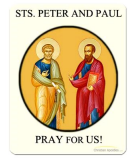
Poor Paul! He came late to the Jesus movement. He never knew the historical Jesus or even witnessed Jesus’ earthly ministry. So of course there is nothing in any of the four gospels about Paul. He first arrives on the scene in the Acts of the Apostles, where he is present during Stephen’s stoning. Paul then persecutes Jesus’ followers. By the time he was finally baptised, his reputation among the disciples was so awful that they would not believe he had become a follower of Jesus. Though Paul eventually reached a mortal understanding with the leaders of the Jesus movement in Jerusalem, it appears to have been a misunderstanding as the battle of words between Peter and Paul in Antioch would reveal (Gal. 2:1-4). These two pillars of the Church, Peter and Paul, did not quite see eye to eye on all issues. According to Acts, it’s possible that they spent no more than a few weeks together throughout their entire lives. But they are eventually united as ‘founders’ of the Church in Rome, even though there was a thriving Christian community there before either set foot in the city. Their shared title of ‘founder’ comes from the legends that each was martyred there; Paul was beheaded and Peter was crucified upside down. Our Gospel this weekend gives us a seminal episode in Peter’s life. In fact, according to Matthew’s gospel, it was this episode whereby Jesus named Simon son of Jonah, ‘Peter,’ which means rock, as he and his confession would be the rock on which the Church was built. Peter’s confession of Jesus as ‘the Christ . . . the Son of the living God’ is a hallmark of the New Testament. Matthew expands the story from what he found in Mark, giving more authority to Peter. Matthew mentions the terms ‘rock’ and ‘Church,’ which are not found in the Markan story. The Matthean story, even more than the Markan story, elevates the importance of Peter and sets the stage for later theological developments concerning the primacy of Peter, and therefore the primacy of the pope.  But today’s solemnity is not for Peter only. It is for Peter and Paul. And thirteen letters, or about twenty-five percent of the New Testament, are attributed to Paul, a self-described apostle who did not witness the historical Jesus, and who seems to have been at odds on some issues with Peter. All of this is to say that no one person, not even Peter or Paul, has a complete lock on what it means to be a follower of Jesus. There is more than one way to live as a disciple. Moreover, being a disciple means not that there will be complete unanimity of opinion on all issues. Instead, being a disciple means simply being a follower of Jesus. These two disciples, apostles even, are our examples for today, each in his own way. QUESTION OF THE WEEK . . .  Have you ever found yourself possessing the ‘keys of the kingdom’ that ‘unlocked’ God’s grace to someone, or has someone ‘unlocked’ such grace for you?  When have you had an exchange like the one between Jesus and Peter in which a rift was healed, a chasm was crossed, a relationship was restored?
By Webmaster June 26, 2026
The musings of one of God’s smallest creatures on events in and around the Parish over the past seven days . . . . Like everyone else in the south of England Fr D has been trying to cope with all the unusually hot weather that we have been experiencing this week. Fr D doesn’t like being hot at the best of times (and would far rather be having to deal with extreme cold). After the morning Masses and a celebration of Infant Baptism last Sunday Fr D was expected at an 80th Birthday Party in his first parish as a parish priest (Reigate). The ‘birthday girl’ was someone who Fr D first met in his first year at the seminary in 1982 when he was working one afternoon a week in her class at a primary school to get some pastoral experience. In the event Fr D stayed visiting the school in question for two years (it was also when he met Fr Tony Clarke who some parishioners will remember as Parish Priest of the Sacred Heart). Many years later, when he was made Parish Priest of Reigate, he met up once more with the (now retired) deputyhead. Following Morning Prayer, Mass, and Exposition on Tuesday morning, Fr D was off down to the diocesan offices in Crawley to continue his work at the Tribunal where he is working on getting another two cases to the point where they can be judged by himself, as the presiding judge, and two associate judges. When he returned late in the afternoon he got himself ready to meet for the last time with the parents of this year’s First Eucharist children. To everyone’s satisfaction the session do not take too long and everyone was home in time for ‘the big match!’ After Morning Prayer and Mass on Wednesday Fr D had some work to do concerning the Pastoral Plan for the Deanery before a quick lunch. He was then picked up by parishioners and taken to Lord’s cricket ground in London to watch the England vs West Indies women’s T20 match. Fr D was really surprised by the whole format of the match (lots of very loud music, almost between each ball), but was greatly relieved that their seating area was under shade. Owing to the cricket and the heat Fr D had real trouble waking up on Thursday morning. Following Morning Prayer and Mass he was off down to Crawley again, making in-roads on his present cases. When he returned in the evening he was meeting the parents of four infants who will be baptised in July, before the summer holidays.  After Morning Prayer and Mass on Friday Fr D was at Notre Dame School where he celebrated with those children in the school who have recently celebrated their First Eucharist . . . . . .
By Webmaster June 26, 2026
From next weekend the new season of Sacramental Applications will be available.  Infant Baptism Applications can be obtained from the Parish Office (during the normal office hours - please remember that baptism is for Registered Parishioners only who are regularly attending our Sunday and Holy Day Masses). These should be completed and returned to the Parish Office a minimum of two weeks before the chosen course.  First Reconciliation/First Eucharist Applications can be obtained (by parents only - not friends or grandparents) from the sacristy after Sunday Mass. Please Note: it is very hard to imagine that someone who is not already a regular member of our worshipping community could possibly be ready to celebrate either of these important sacraments at this time. These too should be completed and returned to The Presbytery by 18.00 on 31st August 2026 (no late applications can be accepted, sorry).  Confirmation Applications are not available yet as the diocese has not given a date for the Confirmation Mass next year so Fr D cannot produce an appropriate schedule for the course. Once he has a date he will make details known. 
By Webmaster June 22, 2026
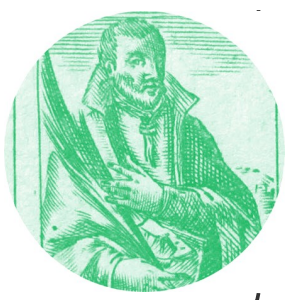
St Thomas Garnet (born 9th November 1575 – died 23rd June 1608) was a Jesuit priest who was executed in London. He is the protomartyr (i.e., the first martyr associated with a place) of Saint Omer and of Stonyhurst College. A nephew of the Jesuit Henry Garnet, he was born in Southwark, England, and studied for the priesthood St Omer in France, and at Valladolid, Spain. Initially ordained as a secular priest, he joined the Jesuits in 1604 and worked to advance the Catholic cause in Warwick until his arrest in 1606.  He was exiled after months of torture but returned again in 1607 and was very quickly arrested once more. This time was executed at Tyburn, London. Beatified in 1929, he was canonized in 1970 and is included among the Forty Martyrs of England and Wales.
By Webmaster June 22, 2026
The musings of one of God’s smallest creatures on events in and around the Parish over the past seven days . . . . A very, very busy week in and round The Presbytery as the First Eucharist programme came to it’s fruition last Sunday . . . . On Saturday morning last weekend Fr D spent time in the church with our First Eucharist families rehearsing what was going to take place at the 11.00 Mass on Sunday morning. The children were able to walk through slowly and ask questions where necessary concerning the ‘Big Day.’ They were also able to practice receiving Holy Communion with un-consecrated hosts and wine. Fr D explained to them that they should receive from the chalice on their First Eucharist and then they could choose if they wanted to do so in the future (not surprisingly none of the children liked the taste of the wine and parents laughed when Fr D said ‘long may it be so!’). At the 11.00 Mass the day after the children were wonderfully turned out (Fr D has a thing about the girls looking like meringues and boys dressed as sailors). Our newly confirmed were also present at the Mass - the boys acting as ‘ecclesiastical traffic cops’ to make sure that the families were not inundated whilst the children received communion for the first time. At the end of the Mass the children lined up outside to shake hands with everyone as they left the church, then they joined Fr D in a photo-call for the paparazzi by the hedge outside the Presbytery. Having celebrated Moring Prayer, Mass, and Exposition on Tuesday morning Fr D was off down to the diocesan offices in Crawley to continue work on another couple of cases that he is moving closer to a judgement session. At present the Tribunal has had more applications than they had in the whole of last year (and we’re not even half way through the year!). When he got back home in the late afternoon Fr D had a ‘Teams’ meeting with the ‘Standards and Ethos’ committee of the Bosco Catholic Education Trust. By the time it came to supper he was really ready to eat and stop ‘doing things.’  On Wednesday Fr D celebrated the funeral of a parishioner before the committal at Randalls Park. He then just about had time to come home, and change his shirt before heading off for his monthly lunch with Fr Ruslan (Walton-on-Thames) at a local hostelry. In the latter part of the afternoon he was preparing his parts of the newsletter before having a sandwich and settling down to watch the England match . . . . .
By Webmaster June 12, 2026
What is Gift Aid?
By Webmaster June 12, 2026
OUR PARISH SUPPORTS THE COBHAM AREA FOODBANK Please can you help local people in crisis by purchasing items on the list below and placing them in the Foodbank’s collection point in the narthex when to come to Mass at the weekend? 
By Webmaster June 12, 2026
IMPORTANT NEWS REGARDING ADMISSIONS TO CATHOLIC SCHOOLS AND THE CERTIFICATE OF CATHOLIC PRACTICE Parishioners may be aware that the Diocesan Education Service has updated its model Admission Policies to bring them in line with the National Catholic Education Service and to ensure compliance with the mandatory School Admission Code which all Admission Authorities are legally required to follow. Our schools will still prioritise Catholic applicants and a certificate of Baptism will still be used to identify this. As schools adopt these new models, the requirement to seek a parish priest’s signature on the Supplementary Information Forms' (SIFs) will be removed. However, in any case where a school is oversubscribed with Catholic applicants, it will be necessary to rank further the Catholic applicants. To do this a 'Certificate of Catholic Practice' (CCP) will be used which affirms that 'this child and his/her family are known to me and, to the best of my knowledge and belief, the child is from a practising Catholic family'. (The Guidance from the Diocese, following the National Catholic Education Service model, states that for the purposes of the Certificate of Catholic Practice, a person is a practising Catholic if they observe the Church’s precept of attending Mass on Sundays and holidays of obligation.) This certificate will be needed for those applying from this autumn for a place at St Andrew’s for Admission in September 2027, and going forward. Initially, in moving to a new system, the onus will be on parish clergy to make a judgement on these matters. However, Deanery clergy and the Diocesan Education Service are working on a form for use in coming years whereby families can indicate and celebrate their participation at Mass; indeed families should regard the change as a reminder of the need to be engaged with the life of the local Church, that is, the parish – not simply because they desire a school place for their child but because it is first and foremost their faith community, because worshipping God and being fed by Christ in word and Sacrament is what we are about and because, as children of God, families want their children to be supported in their journey of faith.  All clergy are committed to supporting parishioners in the difficult task of parenting and the joyful task of sharing faith and are not oblivious to the challenges that families face. Please trust them in this new situation - but please do not put them in the awkward position of being asked to provide a certificate for someone they have hardly ever seen before.
By Webmaster June 12, 2026
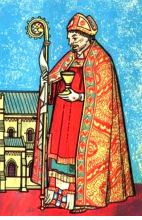
Born at Wyche, Worcestershire, Richard was orphaned while a young lad, he managed to regain his fortune which had been mismanaged by others, and was educated at Oxford, Paris, and Bologna. He earned a doctorate in law from the University of Bologna and was appointed chancellor of Oxford in 1235. After accompanying Edmund Rich into retirement at the abbey of Pontigny, France, he departed the community upon Edmund’s death, taught at the Dominican house in Orkans, and was ordained there in 1243. Upon going home to England, he was named chancellor to St Boniface of Savoy. When King Henry III appointed Ralph Neville to the see of Chichester in 1244, Boniface declared the nomination invalid and named Richard to the post, an act which caused an uproar in the kingdom. Finally, in Pope Innocent IV decided in Richard’s favour, but Richard was prevented from entering his palace by the machinations, of Henry. Only after the king was threatened with being excommunicated was he able to take up his duties. He insisted upon strict discipline among the clergy, aided the poor, and denounced the corruption and vices of the contemporary Church as well as the royal court. His death came at Dover, in a home for poor priests, whilst he was delivering a plea for a crusade.  Richard was canonized in 1262, and his tomb became a popular shrine noted for its miracles up until the Reformation.