NEW 2026-7 SACRAMENTAL PROGRAMMES APPLICATIONS FORMS

Webmaster • June 5, 2026

From next weekend the new season of Sacramental Applications will be available.


Infant Baptism Applications can be obtained from the Parish Office (during the normal office hours - please remember that baptism is for Registered Parishioners only who are regularly attending our Sunday and Holy Day Masses). These should be completed and returned to the Parish Office a minimum of two weeks before the chosen course.


  First Reconciliation/First Eucharist Applications can be obtained (by parents only - not friends or grandparents) from the sacristy after Sunday Mass. Please Note: it is very hard to imagine that someone who is not already a regular member of our worshipping community could possibly be ready to celebrate either of these important sacraments at this time. These too should be completed and returned to The Presbytery by 18.00 on 31st August 2026 (no late applications can be accepted, sorry).


  Confirmation Applications are not available yet as the diocese has not given a date for the Confirmation Mass next year so Fr D cannot produce an appropriate schedule for the course. Once he has a date he will make details known.


By Webmaster June 5, 2026
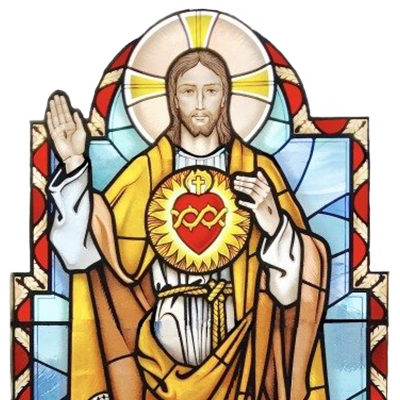
Devotion to the Sacred Heart of Jesus goes back at least to the 11th century, but through the 16th century, it remained a private devotion, often tied to devotion to the Five Wounds of Christ. The first feast of the Sacred Heart was celebrated on August 31, 1670, in Rennes, France, through the efforts of Fr Jean Eudes (1602-1680). From Rennes, the devotion spread, but it took the visions of St Margaret Mary Alacoque (1647-1690) for the devotion to become universal. In all of these visions, in which Jesus appeared to Margaret Mary, the Sacred Heart played a central role. The “great apparition,” which took place on June 16, 1675, during the octave of the Feast of Corpus Christi, is the source of the modern Feast of the Sacred Heart. In that vision, Christ asked that Margaret Mary request that the Feast of the Sacred Heart be celebrated on the Friday after the octave of the Feast of Corpus Christi. The Sacred Heart of Jesus represents not simply His physical heart but also His love for all mankind.  The devotion became quite popular after Margaret Mary’s death in 1690, but, because the Church initially had doubts about Margaret Mary’s visions, it wasn’t until 1765 that the feast was celebrated officially in France. Almost 100 years later, in 1856, Pope Pius IX, at the request of the French bishops, extended the feast to the universal Church. It is celebrated on the day requested by our Lord – the Friday after the octave of Corpus Christi, or 19 days after Pentecost Sunday.
By Webmaster June 5, 2026
There will be no Mass on Tuesday (9th) morning this week as all the clergy of the diocese are attending an annual ‘in-service’ course on Monday and Tuesday of this week.
By Webmaster June 5, 2026
IMPORTANT NEWS REGARDING ADMISSIONS TO CATHOLIC SCHOOLS AND THE CERTIFICATE OF CATHOLIC PRACTICE Parishioners may be aware that the Diocesan Education Service has updated its model Admission Policies to bring them in line with the National Catholic Education Service and to ensure compliance with the mandatory School Admission Code which all Admission Authorities are legally required to follow. Our schools will still prioritise Catholic applicants and a certificate of Baptism will still be used to identify this. As schools adopt these new models, the requirement to seek a parish priest’s signature on the Supplementary Information Forms' (SIFs) will be removed. However, in any case where a school is oversubscribed with Catholic applicants, it will be necessary to rank further the Catholic applicants. To do this a 'Certificate of Catholic Practice' (CCP) will be used which affirms that 'this child and his/her family are known to me and, to the best of my knowledge and belief, the child is from a practising Catholic family'. (The Guidance from the Diocese, following the National Catholic Education Service model, states that for the purposes of the Certificate of Catholic Practice, a person is a practising Catholic if they observe the Church’s precept of attending Mass on Sundays and holidays of obligation.) This certificate will be needed for those applying from this autumn for a place at St Andrew’s for Admission in September 2027, and going forward. Initially, in moving to a new system, the onus will be on parish clergy to make a judgement on these matters. However, Deanery clergy and the Diocesan Education Service are working on a form for use in coming years whereby families can indicate and celebrate their participation at Mass; indeed families should regard the change as a reminder of the need to be engaged with the life of the local Church, that is, the parish – not simply because they desire a school place for their child but because it is first and foremost their faith community, because worshipping God and being fed by Christ in word and Sacrament is what we are about and because, as children of God, families want their children to be supported in their journey of faith.  All clergy are committed to supporting parishioners in the difficult task of parenting and the joyful task of sharing faith and are not oblivious to the challenges that families face. Please trust them in this new situation - but please do not put them in the awkward position of being asked to provide a certificate for someone they have hardly ever seen before.
By Webmaster June 5, 2026
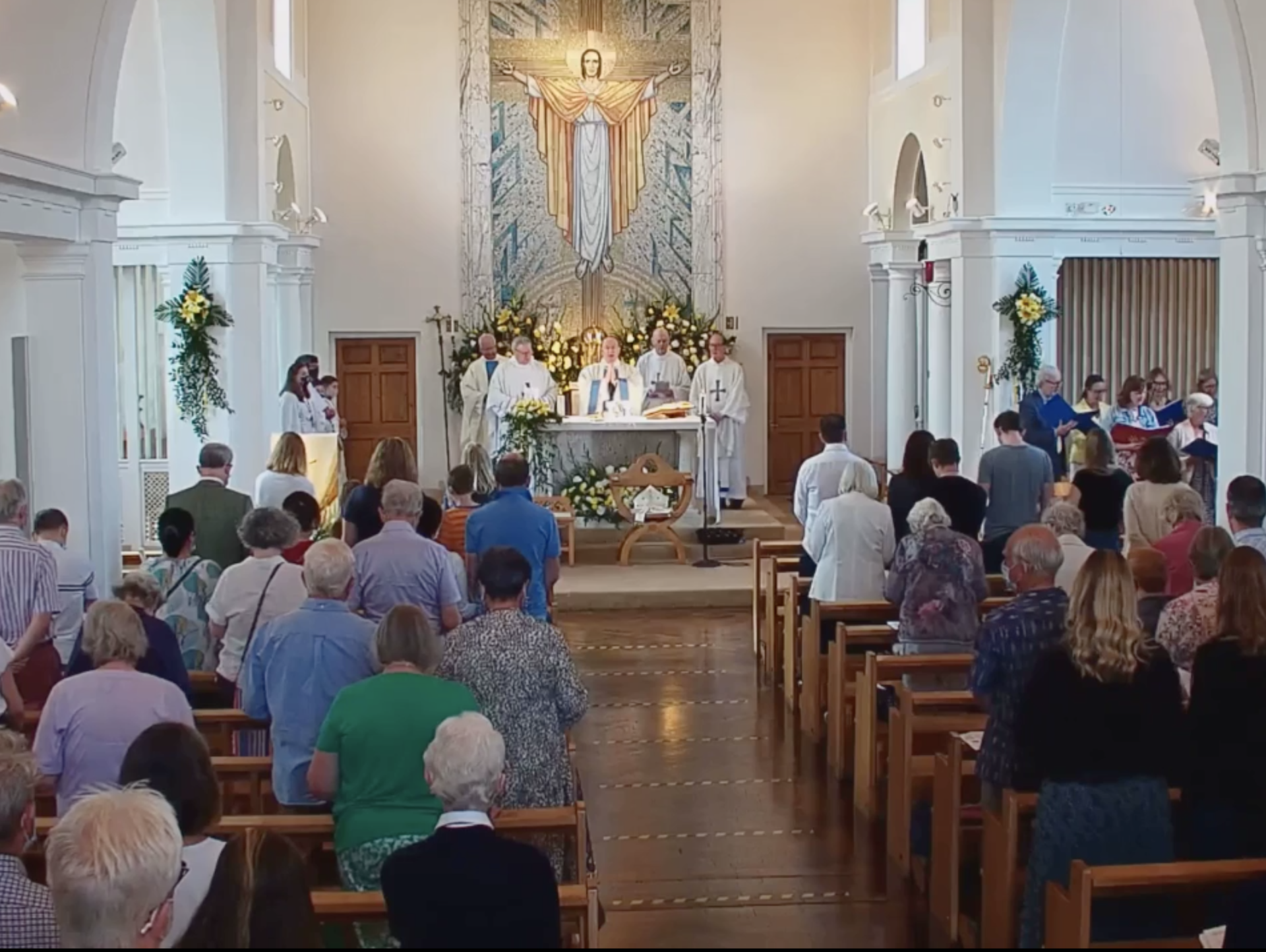
The musings of one of God’s smallest creatures on events in and around the Parish over the past seven days . . . . Another full-on time this week around The Presbytery, as we prepare for our annual period of extended Exposition of the Blessed Sacrament and final preparations for our younger members to receive the Eucharist for the first time . . . . . After Morning Prayer, Mass, and Exposition on Tuesday Fr D was making an early start on his parts of the newsletter as he knew that the rest of the week was fairly full. He also spent time preparing the last session with parents before their children receive the Lord for the first time in the Eucharist (June 14th). In the afternoon Fr D continued working on the Parish Calendar for all the Sacramental Programmes for the next year (2026-7), trying to fit them around school holidays and his own diary. In the evening he met with the First Eucharist parents for the last time before the ‘Big Day!’ On Wednesday following Morning Prayer and Mass Fr D pulled together the last pieces of information for the Parish Calendar and began the work of producing the next year’s Application Forms (Baptism, First Reconciliation and First Eucharist). In the early evening Fr D had his last ‘input’ evening with our newly confirmed youngsters, reflecting on the course and the celebration of the sacrament and looking forward to ‘What’s Next.’ After Morning Prayer and Mass on Thursday Fr D was off in the car to the diocesan offices at Crawley where he wrote up two marriage case sentences that had been judged a couple of weeks ago before starting the work on another case which he will call a judgement session for later. At the present moment in time the Tribunal has received as many cases this year so far as the whole of last year produced! When he returned in the late afternoon he finished up the last of his parts of the newsletter ready to hand the rest over to Sarah in the Parish Office.  Following Morning Prayer and Mass on Friday morning Fr D made preparations for meeting with the family of a parishioner whose requiem will be celebrated here in a couple of weeks time. Whilst working in his office in the morning Fr D also emailed the church lighting engineers to schedule ‘phase two’ of the new church lighting system (this will involve the following: new LED units to light the Stations of the Cross; new LED lighting units for the wall wash lights; new LED fittings for the Altar; an LED reading lamp for the Ambo; new LED units for the ‘Quiet Room;’ a new LED unit for lighting the Stained glass window; and the Organ area lighting) . . . .
By Webmaster June 5, 2026
The Gospel reading today picks up partway through a dispute between Jesus and some quarrelling Jews. Jesus told them bluntly, “I am the bread of life... who ever eats of this bread will live forever” (6:35). The Jews, of course, are confused when they imagine literally chewing on someone’s flesh and drinking his blood. We can understand this confusion when we as Catholics teach children about this mystery of the Eucharist. In their literal way of understanding, kids are confused too about how bread and wine could possibly be Jesus’ body and blood. As adults, though, we can move beyond a need for literal understanding (how can the consecrated host be Jesus’ body if it still looks and tastes like bread?) to try to accept a mystery that our minds will never be able to explain. In the same way, we recognize that Jesus worked miracles of healing that science can’t explain, and we believe that he rose from the dead even though everything else in our lives tells us that would be impossible.  A few verses after today’s passage, the Gospel writer tells us that “many of his disciples turned back and no longer went about with him” (Jn. 6:66) because of this difficult teaching. Others, like Simon Peter, chose to stay with Jesus. The difference between those who turned away and those who stayed was one of being willing to take a leap beyond rational understanding. The Israelites who were given manna in the desert took a leap of faith and chose to eat it - and they survived because of it. They could have left it on the ground and starved to death because they couldn’t under stand where it appeared from or what it was. In the same way today, Jesus offers us himself - in the Eucharist, in scripture, and the physical company of believers, “the body of Christ.” We can open ourselves to receiving the food he sends us, or we can refuse it because we don’t understand it. Questions of the week  How has God fed you during a lean time in the past? What blessings did God send that got you through your desert?  Is it easy or hard for you to get past trying to understand Jesus’ real presence in the Eucharist on a rational level? In what ways?
By Webmaster June 5, 2026
11.00 SUNDAY MASS COFFEE Rota Currently we are looking for parishioners (especially those who use the 11.00 coffee session) to consider becoming new members of the Coffee Rota (like any rota, the greater the number of volunteers the less often the same names crop up). This role is ideal for younger families to take part in as well as others (married or single).
By Webmaster May 30, 2026
Last Monday 25th May, Pope Leo XIV’s first encyclical letter, Magnifica humanitas, was presented in the Vatican’s Synod Hall. Professor Anna Rowlands, a theologian and Professor at Durham University, was one of the speakers at the presentation. Following the launch event, Professor Rowlands reflected on this significant day and what it means for the Church and for the world: “The day has been pretty exciting, intense and momentous, as you would expect. This is the first time that a Pope has attended in the modern era, at least, the launch of a papal encyclical. Today there was a sense of a really important issue and set of topics being addressed, but also of a real gathering together with a spirit of appropriate celebration of a text that I think is a gift to the world.” Turning to the encyclical, Professor Rowlands noted that Pope Leo has been focused on AI as a central issue since the beginning of his papacy. She explained: “I think he genuinely feels that we’re living on the cusp of a new phase of the industrial revolution, and that we’ve entered a new moment where those same issues, in an intensified way, are now present to us again.” Describing the urgency with which Pope Leo is approaching the topic, she said: “[The Pope] thinks that this is an issue we should have been thinking about yesterday, and I think he worries, genuinely, that people don’t feel confident to tackle the AI conversation. He wants people to feel confident; their expertise doesn’t need to be in science or tech to engage with this issue. We do need the people with those bodies of expertise, but we are experts in humanity. We know what it is to inhabit a human body, to desire real human relationships rather than mere artificial connection with each other.”  The central focus of Magnifica humanitas is the dignity of the human person, and the need to ensure “the genuine flourishing of human beings.”
By Webmaster May 30, 2026
St Justin Martyr never ended his quest for religious truth even when he converted to Christianity after years of studying various forms of pagan philosophies. As a young man, he was principally attracted to the school of Plato. However, he found that the Christian religion answered the great questions about life and existence far better than the philosophers. Upon his conversion he continued to wear the philosopher’s mantle, and became the first Christian philosopher. He combined the Christian religion with the best elements in Greek philosophy. In his view, philosophy was a pedagogue of Christ, an educator that was to lead one to Christ.  St Justin Martyr is known as an apologist, one who defends in writing the Christian religion against the misunderstandings and many attacks of the pagans. Two of his so-called apologies have come down to us; they are addressed to the Roman emperor and to the Senate. For his staunch adherence to the Christian religion, Justin was beheaded in Rome in 165.
By Webmaster May 30, 2026
On this feast of the Most Holy Trinity, otherwise known as Trinity Sunday, each reading points to different aspects of God’s identity. The first reading recounts the glimpse of the creator God whom Moses encountered on Mount Sinai: a “merciful and gracious God, slow to anger and rich in kindness and fidelity.” Paul’s Letter to the Corinthians reminds us of the gifts that each person of the Trinity has to offer us: “the grace of the Lord Jesus Christ and the love of God and the fellowship of the Holy Spirit.” In the Gospel reading, John tells us of a God who loves us so much that he allowed his Son to leave his side and come into our world to experience human life. The Gospel passage begins with the famous verse referenced on placards in the crowds at popular sporting events: John 3:16. “For God so loved the world that he gave his only Son so that everyone who believes in him might not perish but might have eternal life.” Martin Luther, the force behind the Protestant Reformation, called this verse “the Gospel in miniature.” Note that John’s view of God’s love and desire for salvation extends to the entire world. God so loved all of humanity that he sent his only Son, not “God so loved the Jews,” or the “early Jewish-Christians,” or the “Christians” who came after the Resurrection. This was a new way of thinking for many believers in Jesus’ time who were locked into a mindset of an “in group” and an “out group.” Even today, many religious traditions can be very exclusive. If you are in the “out group” there isn’t much chance of working your way into the “in group” except through exacting work.  This passage suggests differently. God wants all people to be saved, and God will welcome all who live in the light (as John goes on to explain a few verses later). God didn’t send Jesus to condemn anyone, but some people choose against Jesus and God, thereby “condemning” themselves. God doesn’t act as a judge; individuals choose for themselves to accept or reject God. Questions of the week  What does verse 3:16 mean to you: “For God so loved the world...”?  Which way of thinking do you tend to lean toward - believing that God is our judge or that we choose our own eternal destiny by how we choose to live our lives?
By Webmaster May 30, 2026
CORPUS CHRISTI 7TH JUNE (NEXT WEEKEND) EXTENDED EXPOSITION - next weekend we will be celebrating our annual extended period of Exposition of the Blessed Sacrament in the Sacred Heart Church from after our Sunday morning 11.00 Mass and ending with Evening Prayer and Benediction at 15.30. At the rear of the church is a ‘sign-up’ sheet for parishioners to say that they will be present so that we know that the entire time period is covered; please sign-up TODAY! EXTRAORDINARY MINISTERS OF THE EUCHARIST - A reminder to all of our Extraordinary Ministers of the Eucharist that it is a requirement of the diocese that your commitment to your ministry within the Parish should be publicly renewed annually. This will be done at our Masses at 09.00 or 11.00 next Sunday (7 th June). Please do make a point to sign your name in the sacristy after the Mass you attend on Corpus Christi so that your renewal can be recorded and sent through to the diocese. Thank you.